Showing posts with label Susan A. Roth. Show all posts

Wednesday, June 28, 2023

 Nativist Methodology Reveals Dearth of Supporting Evidence for “Invasive”-plant Ideology


The alien “invasive” Bradford Pear tree (Pyrus calleryana) often grows alongside native Eastern Redcedar trees (Juniperus virginiana) in disturbed-soil sites, adding diversity to the landscape that better provides for wildlife. While the redcedar and the pear both make fall fruits that provide food for birds in winter, the redcedar doesn’t provide flowers for pollinators in spring as the pear does. Nativists need to look at the big picture so they can grasp the value that so-called invasive plants add to our developed (aka “disturbed”) landscapes. 


ALL TEXT AND PHOTOS © Marlene A. Condon


Four years ago, I wrote an article entitled, “Ecologists Recognizing Value of Alien Plants”. It referenced an opinion piece signed by 19 ecologists (every one of whom possesses a Ph.D.) who disagreed with the nativist take (the policy of favoring native plants) on so-called invasive plants.

 . 

https://www.crozetgazette.com/2019/02/11/blue-ridge-naturalist-ecologists-recognizing-value-of-alien-plants/


The next month, three people signed their names to a letter blasting me for my article.


https://www.crozetgazette.com/2019/03/12/to-the-editor-the-blue-ridge-naturalist-not/#comments


Their letter perfectly illustrates the methodology employed by any group that supports a weak cause. To help you recognize the tactics employed by people to convince you to join a fight not well supported by facts, I will provide examples from the above-referenced letter to the editor. For efficiency, I will refer to the three letter writers as The Triad.


The first clue that people don’t have much to say in defense of their beliefs is evident when they immediately attack someone’s personal integrity and knowledge instead of simply supplying support for their side of the story. The Triad started off their letter by writing that “[my] bias and manipulative language displays itself in every paragraph as [I portray] ‘plant nativists’ and invasion biologists as extremists with an evil agenda that will cost you, the taxpayer, millions of dollars in unnecessary and wasted spending.”


In reality, I had written about a current and ongoing activity to support my contention that “Critical thinking is a must for deciding invasive-plant policy to avoid harming wildlife and wasting millions in tax dollars.” I wrote that, “In the name of ‘saving’ the environment from so-called invasive plants, a movement has sprung up to remove Eucalypt (Eucalyptus globulus) trees from California [even though these Australian trees] now serve as the most frequented overwintering sites for the western Monarch butterfly population.”


https://milliontrees.me/2013/11/01/monarch-butterflies-in-california-need-eucalyptus-trees-for-their-winter-roost/


Another clue that people are pushing a weak agenda is when they lie about their adversary. Thus, The Triad went on to write that I cited “as a scientific reference an eight-year-old Comment [sic] in the journal Nature by Mark A. Davis and others.”


No, I had made quite clear that the article was “an opinion piece [emphasis mine] signed by 19 ecologists in the journal Nature” in which they argue that “policy and management decisions must take into account the positive effects of many invaders.”


https://www.nature.com/articles/474153a


Often, people arguing a rather invalid point of view employ flimflam. They cite scientific sources that are fallacious, wrong, and/or misleading because those papers support their viewpoint.


“Condon appears to ignore and does not cite the vast amount of peer-reviewed literature on the damaging effects of nonnative plants. For example, recent research published by Narango et al., in the October 22, 2018, issue of the Proceedings of the National Academy of Science demonstrates that native plants are best for birds.”


Even if I were in agreement with The Triad, I would never cite this deceptive research that chose a forest-dwelling bird as representative of a species that can live in suburbia without human assistance, which it can’t. The scientists should have chosen a more-appropriate species, such as Northern Cardinal, American Robin, Gray Catbird, Northern Mockingbird, etc. Please see “Chickadee Chicanery” at this web site for a full exposé of this study.


https://indefenseofnature.blogspot.com/2020/10/a-carolina-chickadeegrasps-tulip-poplar.html


An American Robin, unlike the Carolina Chickadee, can find food in un-pesticided lawn grass, making it a suitable subject for study in suburbia to determine how well some bird species can survive among alien plants.


A ploy people often use when pushing a shaky narrative is overemphasizing the value of supposed facts that support their opinion. The Triad wrote that “Scientists have determined that our migrating birds require high-fat foods to fuel their southward flights in autumn. However, autumn olive berries are sugary sweet treats, the junk food of the bird diet. Smith et al. demonstrated that autumn olive fruits provide about half the nutrition of several types of native fruits, such as dogwood, at the time of year when North American migrating songbirds need fat, not carbohydrates, to fuel their long flights. (“Fruit Quality and Consumption by Songbirds during Autumn Migration,” Wilson Journal of Ornithology, March, 2007).”  


When I looked up this study, I found that it states that “Most common fruits [emphasis mine] on Block Island [where the study took place in Rhode Island during bird migration] contained primarily carbohydrates...and little protein...and fat. [emphasis mine]”


As the research paper’s authors were mainly speaking of native plants, this statement in no way supports the letter writers’ contention that the researchers demonstrated that Autumn Olive fruits were inferior nutritionally to native fruits—because most of the native fruits were primarily sugar (carbohydrates), too!


The Triad doesn’t understand the science of nutrition, which is “the assimilation by living organisms of food materials that enable them to grow, maintain themselves [emphasis mine] and reproduce.” (www.britannica.com/science/nutrition)


Sugar is a natural source of energy that’s useful for everyday activities. When migrating songbirds need to stop to rest and “refuel”, they need energy to hop around to find food, and Autumn Olive fruits fill the bill. These sugary fruits serve birds in the same manner as jelly beans (that are mostly sugar) serve a runner in need of glucose to continue exercising.


The research paper’s authors also state that “fruit selection by birds on Block Island was not simply related to differences in macronutrient composition between fruits...studies of wild and captive songbirds have shown that some species preferentially select high-fat fruits...or high-sugar fruits [emphasis mine]...”, which hardly implies that Autumn Olive fruits are “junk food”.


High-sugar fruits, such as Autumn Olive (Elaeagnus umbellata, seen here), provide energy needed to keep animals going about their day-to-day activities.


People will often accuse someone of wrongdoing as they themselves supply their own prevarication: “Condon mistakenly asserts that “nativists” (a derogatory term she uses for people who encourage planting only native plants in their gardens and in our natural areas) insist that all alien plants are problems and must go. [emphasis mine]”


That was not true. I wrote that, “Rather than critically analyzing each situation and dealing with it in the most appropriate manner, plant nativists (people who practice a policy of favoring native plants over nonnative) take the approach that demands removal of every plant designated as ‘invasive [all emphasis mine], no matter what function it is fulfilling in the local environment or how well it fills what would be an otherwise empty ecological niche.”


Also, I defined “nativist” in a way that literally describes the basic belief of nativism, which is hardly “derogatory”.


Nativists abhor Japanese Knotweed (Fallopia japonica syn.Polygonum cuspidatum) despite the value of its blooms to pollinators, such as this Four-toothed Mason Wasp (Monobia quadridens) and numerous tiny bees. A so-called invasive plant, it has “stayed put” where I planted it decades ago. 


A sure-fire proof that someone doesn’t have a case is when they go off on a tangent that’s nonsensical: “While it appears that many nonnatives, such as Japanese knotweed, which Condon mentions in her recent article, provide shelter for animals, that shelter is not always useful and appropriate for many species. Take the bobwhite quail, for instance…that need shelter that allows them to move about quickly… [such as] clump-forming grasses whose structure offers ground-level spaces beneath dense, overhead cover.”


The Triad went off on a strange tangent here, since the point they make with bobwhite quail is nonsensical in the extreme. They are suggesting that somehow nonnative plants are supposed to fulfill shelter requirements for ALL animals, which, of course, is utter nonsense. Even those native clumps of grass they talk about are not going to shelter ALL animals.


When an argument is seriously lacking substance, people fall back on their credentials in the hopes that it will fool people into thinking they are experts: “Susan A. Roth holds a BS and an MS in Ornamental Horticulture from Cornell University and is the author of 10 gardening books.  William Hamersky holds a BS in Wildlife Biology from SUNY College of Environmental Science and Forestry and a MS in Biology from California State University, Hayward. Manuel T. Lerdau is a Professor of Environmental Science and of Biology at the University of Virginia and has a PhD in Biology from Stanford.”


Ms. Roth’s advanced degrees in Ornamental Horticulture in no way prepared her for dealing with the natural world because, until very recently, horticulturists mainly saw most wild critters as “pests” and native plants as “weeds”—all of which were to be killed if they found their way into one’s garden.


Mr. Hamersky’s degrees should have prepared him with a better understanding of how the natural world works, yet—based upon his signing on to this letter—he’s apparently unaware of the fact that environmental conditions determine where plants are found. Someone with real knowledge of the real world should be able to see there’s no such things as “invasive” plants, but rather environmental conditions that encourage these plants to do well in particular areas.


Professor Lerdau’s qualifications outrank those of Roth and Hamersky, which might fool people into thinking that certainly he must be someone you could trust. Yet, he signed on to a letter rife with unfounded accusations, insults, lies, and misleading arguments.  


Unlike the three letter writers who should be embarrassed by, and ashamed of, their letter to the editor of The Crozet GazetteI can truthfully say that I can back up everything I’ve ever written.


NATURE ADVICE:


Use common sense to determine whom you can believe when people disagree about an environmental narrative. Who makes sense and who doesn’t? Who employs facts instead of insults? Who’s calm instead of angrily supplying emotional responses? If someone needs to tout a degree, is it a sign he doesn’t know as much as he’d like you to believe he does? And, most importantly, don’t buy into a false narrative just because a majority of people have done so. That’s how slavery and other evils have been able to persist in the world—people are afraid to swim against the tide lest they be severely criticized and perhaps embarrassed or even punished (as I have been by losing jobs). But sometimes, you must be brave and stand up against what you know is not right.   


DISCLAIMER:


Ads appearing at the end of e-mail blog-post notifications are posted by follow.it as recompense for granting free usage of their software at the author's blog site. The author of this blog has no say in what ads are posted and receives no monetary compensation other than the use of the software. 

Saturday, March 25, 2023


Garlic Mustard—Exposing a Trail of Lies, Hearsay, and Ignorance

Garlic Mustard is claimed to be allelopathic, meaning that it makes the soil inhospitable for native plants to grow nearby. This claim is undoubtedly based upon the fact that this species is often the only plant found growing in some otherwise-barren areas. But a picture is worth a thousand words when it comes to disproving mis- and dis-information. As clearly seen here and in many other photos I’ve taken, even the most-adored plants (in this case, Dutchman’s Breeches, Dicentra cucullaria) can grow and bloom(!) in the vicinity of Garlic Mustard.


ALL TEXT AND PHOTOS © Marlene A. Condon


NOTE: The term “nativist” employed in this article refers to an advocate for policies that support the protection of native plants by removal of “invasive” alien plants.


“Blue Ridge PRISM [Partnership for Regional Invasive Species Management] Inc began as a volunteer-driven organization dedicated to reducing the negative impact of invasive plants in the northern Blue Ridge Mountains of Virginia. Effective invasive plant control is a community and neighborhood issue because these aggressive plants know no boundaries – flowing water, birds, hikers, vehicles, and animals [sic] scat all help to spread their seeds.”


https://blueridgeprism.org/about/


I don’t see how anyone could write that supposedly invasive plants are “aggressive” when it’s immediately stated that they are being spread by other entities. The statement is nonsensical and perfectly epitomizes the entire “invasive-plant” narrative: Blame plants for simply responding to environmental conditions. Nativists don’t recognize that by their own articulation of the “problem”, they expose the fatal flaws in their thought processes: a lack of perception and reasoning ability.    


Consequently, this organization commonly promotes misinformation that often employs an unhealthy dose of anthropomorphism. For example, the subtitle of a Blue Ridge PRISM "fact" sheet on Garlic Mustard (Alliaria petiolata) by Susan A Roth declares that Garlic Mustard is a “beastly invasive” that “[m]urders crops, [w]ildflowers, and [f]orests, [p]oisons the land” and “[k]ills butterflies”. 


https://blueridgeprism.org/wp-content/uploads/2021/09/Garlic-Mustard-Factsheet-2021-9-9-v1-FINAL.pdf)


The clear intention of Ms. Roth’s hyperbole is to make you believe you must rid your yard and neighborhood roadsides of this medicinal and culinary herb. But let’s look at the facts instead of PRISM factoids. 


The fourth sentence of this PRISM “fact” sheet states that, “By now, garlic mustard is destroying forests and killing butterflies in 34 states, ranging from the Northeast and Mid-Atlantic to the Midwest into the Pacific Northwest and Alaska.” This kind of overstatement is common in nativist attacks on so-called invasive plants, as is the fact that appropriate references are rarely provided to presumably support such exaggeration—as is the case with this web document. A lack of references should make the reader suspicious of the validity of such rhetoric, and with good reason, because it’s usually scaremongering based upon hearsay.


For example, the second paragraph tells us, “Within ten years of its arrival in an area, garlic mustard can take over the forest floor.” Really? I have just celebrated living in the same house for the past 37 years. My yard, in the shadow of the Blue Ridge Mountains, is surrounded by forest. Garlic Mustard grows in this area, but I can truthfully declare that it has made no attempt to “take over” the forest floor that surrounds me, and has only appeared in my yard twice—both times disappearing after setting seed.


Instead, Garlic Mustard has stuck to roadsides where the highway department distributes its seeds by sending out mowers in the fall (after the plants have gone to seed). Thus, Garlic Mustard’s spread can be directly attributed to people, as is typically the case with so-called invasive plants. And, if you don’t understand the true source of a problem, you are never going to be able to fix it (in this case, by mowing before Garlic Mustard has set seed).


In horticulture, the saying, “Right plant, right place” should tell everyone that plants grow only where environmental conditions are right for them. In other words, if conditions (amount of light, soil tilth, moisture) were conducive to native-plant growth in a particular area, those plants—rather than alien plants—would have come up and filled the area instead. Of course, it’s difficult for that to happen when the highway department keeps roadsides cut and the soil compacted, as well as polluting the soil with a salt slurry in winter. Let’s face reality here:  Human-maintained roadsides invite the toughest of nonnative plants to move in while discouraging less resilient native plants that can’t withstand such harsh growing conditions.


Yet, according to nativist postulation, garlic mustard should have “invaded” the forest floor and taken it over long ago in my area, which simply has not happened. Why? Because this plant needs a measure of sunlight and soil disturbance that you will not find in undisturbed forests.


So how did this myth of taking over forest floors get started? I suspect it’s because people don’t scrutinize what they’re looking at. Garlic Mustard growing along trails into the forest is simply following a cleared pathway of exposed soil. The extent of their spread away from the path depends upon how much the surrounding forest has been thinned (thus allowing sunlight to reach the ground) and whether the soil is covered with enough leaf litter (so soil is not exposed).


In other instances, Garlic Mustard spreads where trees exist but aren’t mature enough to create a forest canopy that adequately shades the soil and covers the ground with spent leaves. Many people incorrectly describe such areas as “forest” when they are more properly called “woods”. Terminology matters. If a writer uses misleading words, he misleads his reader—which is archetypal for papers about “invasive” plants.     


Now, how about those butterflies being killed in 34 states? Naturally, no reference was supplied by Ms. Roth, the author of the Blue Ridge PRISM “fact” sheet. So, I tried to find this information online.


The first paper I looked at was from the Urban Forest Alliance in McLean, Virginia, where the text was identical to that of the PRISM paper. Worse yet, the first suggestion supplied at the end of the paper for “more information” was the PRISM “fact” sheet! As is common with so-called invasive-plant articles by nativist advocates, one paper references another that either replicates exactly the text (as in this case) or repeats the message, albeit in different words. When trying to verify information, you go around in circles because valid information does not exist in articles written by nativist environmentalists.


Even when looking at more-recent scientific papers in which references are cited, you often find that the researchers don’t seem to have read them because the papers referenced don’t concur with what the scientists are putting forth. For example, many scientists proclaim that Garlic Mustard is the cause of the decline of the West Virginia White (a butterfly), and virtually all these folks reference a 1971 paper by S.R. Bowden, an English lepidopterist (one who studies butterflies and moths).


It took over a year to track down this paper that people greatly reference as providing proof of the toxicity of Garlic Mustard to the West Virginia White’s caterpillar, as well as the supposed ineptitude of the female butterfly by claiming the ovipositing (egg-laying) female often makes the “mistake” of laying eggs on nonnative Garlic Mustard.


First, the Bowden paper that gets referenced so often did not prove the female West Virginia White makes the “mistake” in the natural world of laying eggs on Garlic Mustard, a plant that’s not palatable to her larvae. Bowden performed what I’d call, “terrarium science”, in which the female had no choice but to lay her eggs on the plants this man made available to her in an enclosed environment. When you have eggs to lay and your choice is a glass surface or an inappropriate plant, you’re going to hope for the best and go with the plant (your young need to eat, after all).


Second, while most people referencing this paper claim the caterpillars were “poisoned” by Garlic Mustard, that is not at all what happened in Bowden’s lab. The caterpillars refused to eat this plant, not unlike a hungry child refusing to eat broccoli! As a result, the caterpillars died from starvation, but the word “poison” connotes evil and is undoubtedly the reason so many native-plant advocates use it when discussing Garlic Mustard and its effect upon the West Virginia White. Always keep in mind: Words matter.


References matter, too. I could not find one reference about butterflies being killed by Garlic Mustard in 34 states, nor could I find a reference to particular butterflies other than the West Virginia White (Pieris virginiensis) being threatened by this plant species. Still, a USDA Forest Service document states that Garlic Mustard posed “a severe threat to the long-term survival of the West Virginia White in many areas [throughout much of its historic range]”, yet also clearly declares that “Forest clearing and fragmentation appear to be the greatest threats [emphasis mine] facing this species.”


 https://www.fs.usda.gov/Internet/FSE_DOCUMENTS/fsm91_054237.pdf


These folks condemn Garlic Mustard, as if it’s obligatory, despite admitting that other threats to this insect’s existence are far greater. In addition to the loss of habitat due to logging or clearing for agriculture and development, additional menaces include insecticides and herbicides employed in nearby agricultural fields and control efforts for Gypsy Moth outbreaks; deer browsing of native plants; and the effects of climate change (local weather).


And another paper, “How Environmental Conditions and Changing Landscapes Influence the Survival and Reproduction of a Rare Butterfly”, points out that even though this butterfly is considered rare, “P. virginiensis is frequently overlooked as it flies early in the spring in forested areas, which are not major sources of butterfly diversity and thus are not often regularly monitored” by butterfly monitoring organizations.


https://www.researchgate.net/publication/271765723_How_Environmental_Conditions_and_Changing_Landscapes_Influence_the_Survival_and_Reproduction_of_a_Rare_Butterfly_Pieris_virginiensis_Pieridae


Obviously, employment of the West Virginia White to disparage Garlic Mustard exemplifies what goes on in “invasive-plant” bashing. First, a likeable “victim” (that may not actually be a victim) is found that will (presumably) make people care enough to take the desired action (getting rid of an “invasive” plant) to “save” it. Second, accusatory overstatements—employed to implant images in people’s minds that aren’t valid—are boldly put forth with very little evidence provided to back them up. Dishonesty is the hallmark for how nativists manipulate people to do their bidding.


In summary, lies (about alien plant species), hearsay (from other nativists), and ignorance (a lack of true botanical knowledge) form the basis of the “invasive-plant” movement.


NATURE ADVICE:

When people have an agenda, you need to be wary of their words. Don’t just buy into what you read or hear. Make your own observations of so-called invasive plants to find out if our wildlife makes use of them and how so, and if research papers are referenced by native-plant advocates, be sure to look them up. These papers often do not corroborate the claims nativists make.


DISCLAIMER: 

Ads appearing at the end of e-mail blog-post notifications are posted by follow.it as recompense for granting free usage of their software at the author's blog site. The author of this blog has no say in what ads are posted and receives no monetary compensation other than the use of the software. 


Friday, December 31, 2021

 When Ideas Remain Unexamined and Unchallenged, They Intimidate

A birds-eye view of the University of Virginia (UHall seen here) in Charlottesville, Virginia, makes clear that there are plenty of native trees to be found in developed areas. 

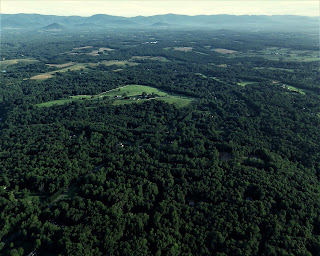
A Charlottesville, Virginia, residential area (seen from a hot-air balloon) has so many trees that you can’t see the roadways interspersed among them. In other words, insects and birds aren’t disappearing because alien plants have replaced native trees.


ALL TEXT AND PHOTOS © Marlene A. Condon


Originally published at Conservation Sense and Nonsense on December 22, 2021


https://milliontrees.me/2021/12/22/when-ideas-remain-unexamined-and-unchallenged-they-intimidate/


The novelist E. L. Doctorow, in a 1989 conversation with PBS journalist Bill Moyers, said, “When ideas go unexamined and unchallenged for a long enough time, they become mythological and very, very powerful. They create conformity. They intimidate.”


He could have been speaking about the current environmental narrative regarding so-called invasive plants. Anyone who speaks out feels the wrath of the folks pushing their fictional environmental manifesto; I’ve lost jobs because of these people.


Most neo-scientists and -environmentalists, having arrived late to the party, have no clue as to why some alien plants exist in profusion along roadways, in former farm fields, and along trails in forests. The popular notion that native plants would otherwise be filling those areas is easily accepted by people who don’t possess knowledge of soil science, or who lack experience with gardening and/or closely observing the natural progression of plants in unmanaged, disturbed areas.


Knowing the prior history of the land is essential to understanding why particular nonnative plants fill some areas. Road building discomposes soil. Trail development/use and cows/farming-equipment moving over the land compact soil. Only “colonizer plants”—those capable of thriving under the altered and nutrient-poor conditions of these sites—can grow there.


Usually such areas, after many years, support a mix of native and nonnative pioneers, but sometimes alien plants outnumber the natives because they are best suited to the constraints imposed by the physical attributes of the site. Anyone (no Ph.D. required) can verify this statement by taking the time to observe the progression of plants in an area not revegetated by people. Doing so would make clear that alien plants do not “push out” native plants by “invading” and “taking over”, but rather, they fill disrupted areas where few native plants can successfully grow.


Yet, the desire by scientists and environmentalists is so great to get folks to remove supposedly invasive plants from the environment that we now have tall tales being spread. Herewith a sampling of some of the most egregiously untrue declarations regarding alien plants.


Johnny Randall, Director of Conservation Programs at the North Carolina Botanical Garden (University of North Carolina at Chapel Hill) wrote a New Hope [North Carolina] Audubon blog post called “Invasive Plants Are NOT for the Birds”.

https://www.newhopeaudubon.org/blog/invasive-plants-are-not-for-the-birds/


·    He writes that, “The scientific literature on invasive plants and bird-dispersal is moderate but growing, and almost all of the research warns that this is a serious and multi-layered phenomenon. First off – birds either do not discriminate between native and invasive plants or often prefer invasives over natives. One reason for this is that a large proportion of invasives are high in carbohydrates, whereas the natives are often higher in protein and lipids/fats. Birds are consequently (pardon the analogy) choosing candy bars over cheeseburgers, which could affect bird nutrition, particularly during fall migration”.


The suggestion that birds are choosing “autumn olive berries [that] are sugary sweet treats, the junk food of the bird diet” is echoed by many people. This quote, from a letter to the editor of The Crozet Gazette by Susan A. Roth, William Hamersky, and Manuel T. Lerdau, Ph.D., (https://www.crozetgazette.com/2019/03/12/to-the-editor-the-blue-ridge-naturalist-not/) is supposedly based upon a study published by the Wilson Journal of Ornithology in March, 2007, entitled “Fruit Quality and Consumption by Songbirds during Autumn Migration”.


Yet this study states that “Most common fruits on Block Island [where the study took place in Rhode Island] contained primarily carbohydrates...and little protein...and fat.” As the research paper’s authors were mainly speaking of native plants, this statement directly contradicts that of Mr. Randall that natives are often higher in proteins and fats than so-called invasives.


Additionally, the research paper’s authors state that “fruit selection by birds on Block Island was not simply related to differences in macronutrient composition between fruits...studies of wild and captive songbirds have shown that some species preferentially select high-fat fruits...or high-sugar fruits...”, which hardly implies that Autumn Olive fruits are a necessarily inferior food choice, as declared by Roth, et al.


A variety of foods exists to serve a variety of purposes. Turning sugar into something “bad” for birds comes as a result, perhaps, of this same application to human nutrition. But sugar is not in and of itself, “bad”. A runner in need of glucose who eats some jelly beans gets a quick burst of energy to continue exercising. There’s absolutely nothing wrong with that.


Sugar is only a problem if it’s eaten in excess, as might be done by children. But birds are not children; if they feel the need for protein and fat, they will search for insects and fruits that offer what they need.


·    Furthermore, Director Randall wrote that “Researchers have also shown that many invasive plants have fruits that persist longer than do native plant fruits into the fall and winter. The invasives are therefore available when our natives are not.”


In a world of disappearing habitat for wildlife because of human development, the fact that fruits on invasive plants are available when native-plant fruits are depleted should be seen as a positive rather than a negative.


·    “Recent research published by Narango et al., in the October 22, 2018, issue of the Proceedings of the National Academy of Science demonstrates that native plants are best for birds. The research showed that yards landscaped with the usual garden center plants, which are mostly nonnative ornamentals, could not support a stable population of chickadees. Yards where native plants composed at least 70 percent of the plantings were able to do so. This is because native plants host more insects than non-natives and therefore provide the necessary high-protein food that birds need to feed their chicks.” [from a letter to the editor of The Crozet Gazette by Susan A. Roth, William Hamersky, and Manuel T. Lerdau, Ph.D., https://www.crozetgazette.com/2019/03/12/to-the-editor-the-blue-ridge-naturalist-not/]


Narango’s study cannot be generalized to all birds, although many people have made the mistake of claiming it can. This study applies only to chickadees and certain other birds that inhabit forest because such species are dependent upon the native plants (trees) that comprise our forestland. In other words, if you want forest birds to reproduce in your yard, your yard must be forest. For a fuller explanation, please read “Chickadee Chicanery” at https://indefenseofnature.blogspot.com/2020/10/a-carolina-chickadeegrasps-tulip-poplar.html


·    These invasive species not only impact our forests, wetlands and streams, but also our economy, health and safety. They kill the trees that shade our homes and that our kids play hide-and-seek around. They increase the presence of other disease-spreading species like ticks. They diminish visibility along trails where safety is important. [quote from an article from the Central Ohio Partnership for Regional Invasive Species Management at a Nature Conservancy-sponsored website https://www.nature.org/en-us/about-us/where-we-work/united-states/ohio/stories-in-ohio/ohio-invasive-species/]


The only “forests” where you will see alien-plant species are those that are either managed improperly (overly thinned and thus allowing too much sunlight to reach the ground under the trees) or those that are actually “woods” in the process of succession (transforming from a field to a forest that has not yet reached maturity). “Invasive” plant species are sun-loving and therefore do not inhabit shady mature forests.


As for killing trees, if “they” refers to vines (a common complaint in the eastern U.S.) one must ask, why was the homeowner unable (or unwilling) to keep a vine from killing a tree in his yard that his “kids play hide-and-seek around”? However, if “they” refers to nonnative animals and/or diseases killing trees, that is a different situation altogether, which is not the point of this article. It’s unfortunate the writer did not make clear what “they” referred to.


As far as I can tell, there’s no proof that “invasive” plants, in general—as stated above—increase the presence of organisms such as ticks. A study published in Environmental Entomology [https://www.researchgate.net/publication/26750666_Managing_Japanese_Barberry_Ranunculales_Berberidaceae_Infestations_Reduces_Blacklegged_Tick_Acari_Ixodidae_Abundance_and_Infection_Prevalence_With_Borrelia_burgdorferi_Spirochaetales_Spirochaetaceae] purportedly shows that barberry-infested plots support more mice and thus ticks than plots in wooded areas with no barberry.


However, the “no barberry” plots were severely browsed by deer and thus “little understory vegetation was present”. In other words, these scientists compared two completely different habitats, which explains the greater number of ticks in the shrubby (Japanese Barberry) area that provided “questing habitat [for] blacklegged ticks [whereas] little other suitable vegetation exist[ed] in [the] severely browsed forests.”


“Questing habitat” refers to plants upon which ticks can wait at the appropriate height to grab onto an animal that comes by. Obviously, ticks are not going to be found in an area with little understory vegetation as they have nowhere to sit and wait for their quarry.


And we’re to believe “invasive” plants diminish visibility along trails, and native plants don’t? It sounds more like the folks who are supposed to be maintaining the trails have been derelict in their duties!


It’s clear that scientists and journalists are doing everything they can to assure that government and the general public view so-called invasive plants in a negative light. Yet, to my knowledge, no study condemning “invasive plants” exists that has the least bit of merit.


 NATURE ADVICE:


It’s important to realize that most, if not all, of the articles written against so-called invasive plants are slanted in their presentation of so-called facts. Try to think critically about what you read.


For example, “invasive” plants are often demonized by giving them attributes that apply equally well to native plants. As soon as you see someone disregarding reality, you can rest assured that their article is untrustworthy.


CONDON’S CORNER An Overdeveloped World Doesn’t Support Wildlife   © Marlene A. Condon 2026 All Rights Reserved      [Published July 9, ...