Showing posts with label Evolution. Show all posts

Saturday, November 16, 2024

PART ELEVEN


Listing of Scientific Names of Organisms Mentioned in the Text

ALL TEXT AND PHOTOS © 2024 Marlene A. Condon


Sachem butterfly at Lantana in the author's yard.

ANIMAL

INSECT

Ant—Family Formicidae

Damselfly, Aurora—Chromagrion conditum

Beetle, Red Milkweed—Tetraopes tetroph

Bug, Large Milkweed—Oncopeltus fasciatus

Butterfly, Monarch—Danaus plexippus

Butterfly, Sachem Skipper—Atalopedes campestris

Butterfly, Variegated Fritillary—Euptoieta claudia

MAMMAL

Ass (Donkey)—Equus africanus asinus

Bear, American Black—Ursus americanus

Cougar—Puma concolor

Cow—Bos taurus; Ox—usually, a castrated adult bull (Bos taurus)

Deer—Family Cervidae; Deer, White-tailed—Odocoileus virginianus; Elk—Cervus canadensis; Moose—Alces americanus

Dog—Canis lupus familiaris

Lion—Panthera leo

Man—Homo sapiens

Raccoon, Common—Procyon lotor

Sheep—Ovis aries

Tiger—Panthera tigris

Wolf—Family Canidae

MARINE

Oyster—Family Ostreidae

REPTILE

Black (or Eastern) Rat Snake—Elaphe obsoleta obsolete

PLANT

Black Knapweed—Centaurea nigra

Daylily—Hemerocallis spp.

Fleabane, Common—Erigeron philadelphicus

Fleabane, Daisy—Erigeron annuus

Lantana—Lantana camerata

Lily, Easter—Lilium longiflorum

Milkweed, Common—Asclepias syriaca

Rose, Cultivated—Family Rosaceae

Strawberry, Domestic—hybrid between Fragaria virginiana and Fragaria chiloensis, two different species native to the Americas

Violet, Common—Viola sororia


The Nature Revelation: God Exists

The Bible Declares It; Evolution Confirms It

© 2024 Marlene A. Condon

THE END


DISCLAIMER:

Ads appearing at the end of e-mail blog-post notifications are posted by follow.it as recompense for granting free usage of their software at the author's blog site. The author of this blog has no say in what ads are posted and receives no monetary compensation other than the use of the software. 

PART TEN

[Published January 14, 2025,  by The Daily Progress, the daily newspaper of Charlottesville, Virginia]
ALL TEXT AND PHOTOS © 2024 Marlene A. Condon

 Addendum—A Basic Explanation of Evolution 

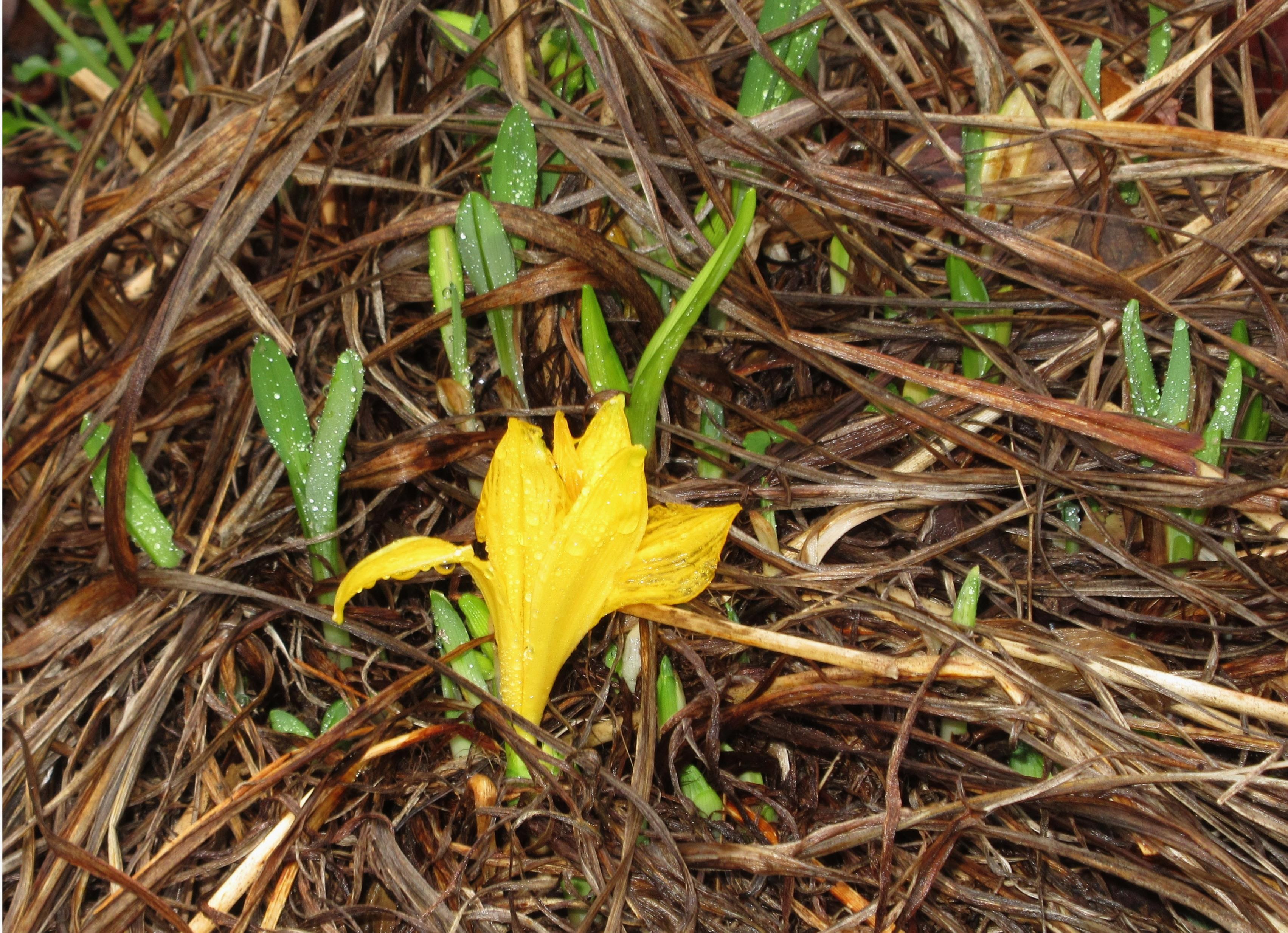
Before Virginia became overpopulated with White-tailed Deer, the author was able to grow an abundance of yellow daylilies.In 2024, these plants demonstrated their will to live, despite being fed upon continuously by deer, by trying to regrow leaves—and in the end, a single blossom—in an unsuccessful effort to perpetuate their kind.

Evolution is a complex explanation of how life forms have changed over time. A common misconception is that it informs us of how life began on Earth, but it does not.


What it does do is explain how populations of organisms become modified over generations, leading to a diversity of organisms, some of which can be quite different from their original ancestors. The driving force behind this biological concept is known as natural selection.


The biological unit of heredity that can change how an individual looks, behaves, and/or how its body works, is known as a “gene”. At its simplest, evolution is about adaptation to one’s environment by way of gene mutations that allow helpful survival traits to be passed on to subsequent generations. It’s a wonderful manner in which to perpetuate life as environmental transformations occur on a physically evolving planet. Of course, it means that the planet is changing biologically as well.


Some folks would argue that the interconnectedness of organisms, as—for example—in the dependence of flowers upon pollinators such as bees to help them reproduce, speaks to “spontaneous creation”. The fallacy here arises due to folks making the mistake of looking at the world as it is today, and assuming it has always been the same. It hasn’t.


Evolution—which fossils corroborate—is the process of life forms going from simple to more complicated. Thus, the first plants were not flowering plants dependent upon insects, but ferns and other primitive plants that could reproduce themselves by self-developed spores.


By the time the much more-intricate flowering plants arrived on the scene, insects not as advanced as bees—such as flies and beetles—existed that could pollinate them. Although bees get the lion’s share of the credit for pollination by insects, numerous other kinds of these creatures assist flowering plants to reproduce, even to this day.


To many people, perhaps especially scientists, evolution killed God. However, this view is wrong, as shown by this treatise. The natural world works perfectly and logically, its function being to perpetuate life in all its wondrous diversity of forms.


Indeed, a life force (which can be described as a push or pull upon an object) exists inside every organism, pushing or pulling it in various directions throughout its life. Unlike in physics, where a force is an external agent capable of impacting a body, the life force is an internal agent comprising an extremely strong will to live.  


My decades of careful nature observations have revealed to me the stubbornness of this force. I’ve witnessed how animals, and even plants, fight to live, even when death—so seemingly feared by all—is inevitable.


The poet, Dylan Thomas, wrote:

 Do not go gentle into that good night,

Old age should burn and rave at close of day;

Rage, rage against the dying of the light.

[https://www.poetryfoundation.org/poems/46569/do-not-go-gentle-into-that-good-night]


But my mother’s experience tells me differently. I don’t believe there is a “dying of the light”, and I hope you won’t either. I don’t believe the life force within each and every organism is extinguished, but rather that it continues on in the universe. Do not fear death; my mom didn’t, and now, neither do I. We are simply “going Home”.


After a summer of continuous feeding by deer upon the daylilies in the author’s yard, these plants—that could not maintain leaf growth to sustain themselves—began to bloom (almost stemless) in mid-fall. It was a last-ditch effort to perpetuate life, should they die, by making seeds. But with cold temperatures and few, if any pollinators active, the plants’ valiant efforts were in vain, though clearly illustrating the life force within that does not surrender easily.  


Tuesday, November 12, 2024

 PART SIX

[Published January 9, 2025, by The Daily Progress, the daily newspaper of Charlottesville, Virginia]

Chapter Four: The Final Evidence That God Exists

ALL TEXT AND PHOTOS © 2024 Marlene A. Condon


These leafy Common Fleabane plants will degrade partially or completely by the beginning of spring and will need to re-grow. So, what is the point of coming up in the fall, a full six months earlier than they can develop fully and flower? Answer: They are a sign of thoughtful consideration by a loving and caring God.


You may wonder how the proof of God’s existence presented in this treatise is distinct from Creationism and/or Intelligent Design. Basically, these two “theories”—or explanations, if you will—ask folks simply to believe a supreme being brought about the universe and everything in it, but they offer no real authentication that shows this assumption to be valid. The Nature Revelation, on the other hand, serves as a testament to what anyone can personally confirm for himself by way of direct observation of the natural world.


Supporters of Creationism see the scientific theory of evolution as problematic due to a lack of fossil-record completeness, or because of other things that are difficult to verify fully (such as more-complex life forms having arisen from much simpler ones, or life arising from non-life). However, evolution is based upon actual physical evidence (such as fossils) and well understood laws of physics and chemistry that allow the aging of soils, etc., that cannot be denied. Reality is the final arbiter of truth.


Evolution is simply a way to explain the documentation available from hands-on research, even if it’s insufficient to answer every question we might have. But that does not necessarily signal it’s wrong, in and of itself, nor that it says anything about whether God exists, or not. 


If God has all eternity to experiment, who’s to say He didn’t just get the ball (the Earth) rolling (by creating it) and is watching patiently to see how things go? Mankind does not need to know exactly how life began or why, but that doesn’t mean we can’t do our best to understand the world, and even the universe, around us in terms of what we know to be physically real.


The primary focus of Intelligent Design, besides expressing concern about evolutionary theory not fully explaining the origin of life and its continuing progression towards a huge variety of life forms, is that nature is complicated, and therefore a designer (God) must be involved in its creation. However, the fossil record does show successively more-intricate life forms with the passage of time; it’s a physical record of life on Earth that attests to this reality of simple to more complex. Thus, it’s hard to definitively argue that you can’t get complexity in nature without a god, although—of course—the fossil record does not necessarily imply this wasn’t the blueprint of a god.


In other words, evolution, Creationism, and Intelligent Design explanations of life on this planet consist of conjecture, not hard-and-fast proof. Only the tenets of the nature revelation put forth previously in this treatise provide genuine evidence of the existence of God.


That said, a singular example in temperate regions of the natural world upholds the idea of an empathetic and caring God—the existence of biennial plants, a type of plant that starts to grow roots, stems, and leaves from seed in the late summer/early fall of the year.


At that time, the biennial (sometime called a short-lived perennial) puts forth a very short stem, and leaves that normally form a rosette at ground level. These leaves invariably degrade to some extent over the winter, if they are not first eaten by herbivorous animals. By spring, when warm temperatures encourage the plant to resume growing, it must grow new leaves and then the flowering stalk(s) to produce seeds for the next generation. When it has accomplished its “mission”, the plant dies.


Botanically speaking, no reason justifies a plant starting to grow as the end of the normal growing season is approaching. Producing leaves that may be eaten or turn to mush by spring, and having then to grow yet more leaves when warmth returns, seems a waste of energy.


If this “strategy” for success of a biennial were truly advantageous, there wouldn’t be far fewer biennial species than perennial and annual ones. So, what is the point of growing over the course of two different growing seasons? There can be only one reason, and that is to supply food for wildlife.


Herbivorous mammals (such as deer and rabbits) that remain active during winter face the difficult task of finding food when there is no fresh growth to be had and cold temperatures are pushing them to find ever more sources of sustenance to maintain their core body temperature. Biennial leaves serve as a source of fresh food. Also, in spring some kinds of insects (such as bees) respond quickly to rising temperatures, coming out of hibernation when a variety of very early-blooming biennials can feed them with nectar and pollen.


Biennials do not really get an evolutionary advantage over perennials and annuals to perpetuate their own species, making their existence an irrefutably valid proof of thoughtful consideration—by God.


The chewed-off leaves of Common Fleabane attest to wildlife use of biennial plants.


Two species of fleabane in the author’s yard provide nourishment to tiny bees from very early spring to early fall, as Common Fleabane blooms are followed by those of Daisy Fleabane.


TOMORROW, PART SEVEN: 
Conclusion—Nature, Man, and God: The Trinity for Life


DISCLAIMER:

Ads appearing at the end of e-mail blog-post notifications are posted by follow.it as recompense for granting free usage of their software at the author's blog site. The author of this blog has no say in what ads are posted and receives no monetary compensation other than the use of the software. 

  CONDON’S CORNER— Out of Touch with Reality © 2026 Marlene A. Condon All Rights Reserved     [Published October 8, 2026, by The Daily Progr...