
The Nature-friendly Garden by Marlene A. Condon
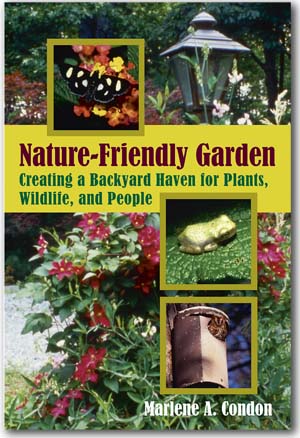
"Creating a Backyard Haven..."
Many people approach gardening as a constant struggle against the outside world. They're perpetually at war with nature, investing in chemical treatments to fight off mammals, birds, and insects in an effort to preserve their garden as a pristine, unspoiled patch of earth.
Marlene A. Condon proposes a radically different method of gardening: What if, instead of battling the natural world, we invite it into our yards?
The result is a nature-friendly garden which attracts and meets the needs of common creatures while maintaining a thriving and varied landscape of flowers and other plants.
As this thought-provoking guide demonstrates, coexisting with nature doesn't mean turning your yard into a bramble-infested wilderness. The sustainable low-impact garden described in these pages is a model of environmental balance, fostering species diversity while keeping wildlife damage at an acceptable minimum.
Best of all, it offers a privileged look at the workings of nature, opening up a new and fascinating world for even the most experienced gardener.
Purchase the book:
To order an autographed book for $19.95 plus shipping, you can order directly from the author by contacting her at marlenecondon@aol.com
Reviews & Testimonials
Waynesboro News Virginian Review
Learning to garden within your natural environment
By Kay Pfaltz
TNV Correspondent
Tuesday, April 18, 2006
When I was first told about this book, I thought to myself, “Another gardening book,” with a sigh. Not that I don’t like gardening. I do. But there are many books already. There are not, however, many (if any) books like this.
“Nature-Friendly
Garden” by Marlene Condon is a much needed, long overdue, wonderful
book that I wish everybody who cares about gardening or the
environment would read. It describes in detail the ways in which we
may create a garden which exists in harmony with nature rather than
in conflict. Many people see gardening as a struggle against the
natural world. They wage constant war against weeds and wildlife.
Having just returned from Lowe’s after reading “Nature-Friendly
Garden”, I was more aware than ever of the dozens of products that
kill insects, mice, weeds, and keep animals (deer, rabbits) away.
Condon proposes we work with our environment, not fight against it.
How
many of us think about how unnatural and even detrimental those large
sweeping grass lawns are to our environment? Lawns are beautiful I
agree, but they are also time-consuming, energy-intensive,
money-draining projects that provide little help for wildlife and
require maintenance which can have harmful effects: pollution from
lawnmower exhaust, runoff from chemical fertilizers and pesticides
that contaminate the water systems from which we drink. As Condon
suggests, why not cut down the amount of lawn and plant flowers,
vines, shrubs and trees instead?
When
we fight against the natural order of things, we create a constant
flow of new problems for ourselves. It seems not only right, but
obvious that we should try to work with Nature and her creatures. For
example we kill off insects that are beneficial to our garden and the
food source to indigenous birds and wildlife. Sometimes ridding our
yards of one species leaves us the target of another. If we know how
to work with wild animals, rarely will they present us with a
problem, yet they will afford us and our children ample fun in
observation.
In
nature nothing is wasted. Accepting the natural process can not only
help our yard and garden, but make our lives easier. For instance,
when we rake up all our leaves in the fall and dump them in the
trash, we work against nature. The best strategy is to let leaves lie
where they fall. In time, leaves decay and become natural fertilizer.
A multitude of organisms feed upon them making their nutrients
available to the tree from which they fell.
“Nature-Friendly
Garden” is filled with what shouldn’t seem revolutionary in the
world of gardening, but unfortunately probably will. There are
wonderful tips to help garden wildlife. Find out why butterflies
collect in damp spots (it’s not to drink water) and how to tell the
sex of a butterfly. There are sections on deer, coyotes, foxes, mice,
raccoons, groundhogs, skunks, opossums, rabbits, bears, squirrels,
turtles, snakes, a variety of insects and birds, bats, newts, frogs
and toads. Condon includes information on mulch and how much is too
much, on the bird-feeding controversy, and the chapter “Providing
Water for Wildlife” discusses great ideas for pond gardens.
If
these few examples are not enough to encourage people towards
nature-friendly gardens, the last chapter, “The Healing Garden,”
points to the correlation between nature and health.
It
was not until May 2000 that I became aware of the concept of a
healing garden. About ten years earlier, some keenly insightful
people had realized that we all might be physically and
psychologically healthier if nature were a part of our lives.
How can nature be such an important component of our health and well-being? Undoubtedly the answer lies in the fact that we are very much a part of the natural world, even though many folks seem to be quite removed from it. Living in cities of concrete and steel or towns paved over with asphalt, it might seem as if contact with nature is nonessential. But even the largest cities have parks, and our federally-preserved natural areas are overcrowded with tourists every summer. There can be no denying that humans feel a need to connect with nature, even if the natural world is not a part of their daily lives.
This
book which is beautifully written is also reader friendly with
photographs on almost every page. There is an excellent “Resources
and Scientific Names” section at the end, as well as a
comprehensive list of plants that best attract wildlife. An
interesting and inspiring book, “Nature-Friendly Garden” points
the direction toward which we as human caretakers of our planet need
to be moving.
-Kay
Pfaltz is the author of “Lauren’s Story: An American Dog in
Paris.” She writes for Nelson County Life and is contributing
editor
for LaJoie.
Review from the Shenandoah Chapter of the Virginia Native Plant Society
New & Reviewed: Nature-friendly gardening book ‘sweetly subversive’
The urgency of spring usually drives me to the far wilds in search of the latest birds and blooms, but sometimes I’m happy just to stay home and see what spring is doing in my yard and gardens. I don’t mean to imply that I am any kind of gardener. I never do the things the garden books and columns tell us to do. So I was happy to read Nature-Friendly Garden and learn that my failure to follow accepted garden practice is the accepted garden practice for creating my own backyard sanctuary.
Nature-Friendly Garden is part manifesto, part how-to book, offering personal observations and sage advice on everything from planning your home landscape to what type of bird seed to put out. Some chapters, though, may go against the conventional grain. Marlene Condon’s approach to invasive exotic plants, for example, may not set well with some VNPSers. Instead of railing against the satanic invaders, she opens the door to the possibility that some non-native plants may have a place in the nature garden. She notes that invasives often become invasive when offered opportunities by our soil disturbing activities and that non-natives may help to restore eroded or compacted soils and prepare the way for more acceptable plants.
In her chapter titled “Limit the Lawn,” Condon offers alternatives to the paradigm that an expansive, expensive lawn is the standard of beauty in home landscaping. What she’s really selling here is a gardening style that replaces micromanagement with a more laid-back style: plant things that are adapted to your immediate environment, lay off the chemicals, leave spent flowers and stalks for wildlife food and cover, adopt a policy of watchful acceptance of non-native plants, pick your battles. Let the garden work for you.
Nature-Friendly Garden is a sweetly subversive little book. It’s not going to put a dent in lawn mower sales, but if it gets into the right hands, it could change a few minds. Put a copy in your library. Give one to your neighbor. Make the world a better place, one yard at a time.
-Mark Gatewood, Shenandoah Chapter, Virginia Native Plant Society
Review from Library Journal
-Deborah A. Broocker, Georgia Perimeter Coll., Dunwoody Copyright 2005 Reed Business Information.
Review from Booklist
-Carol Haggas Copyright American Library Association. All rights reserved.
All creatures concern local writer
Review by Barbara Rich
Daily Progress correspondent
Sunday, June 18, 2006
If local writer and photographer Marlene A. Condon and former Vice President Al Gore knew one another - and perhaps they do - it would be a meeting made, not in heaven, but right here on Earth. Both have a profound concern for all things environmental, but while Gore concentrates on the global, all creatures large and small - especially those small ones affecting a garden - motivate Condon.
In her new book, "Nature-Friendly Garden," the reader will find homage paid to the most minute animal and insect; the most modest garden; the most unprepossessing flower, i.e., the lowly dandelion. All these, and more, are lovingly described and photographed. All attest to Condon’s passion that they not only be allowed to survive, but thrive.
Condon, who lives in Crozet, tells us much of what is in store in her introduction: "In this book, I share what I have learned about gardening by letting the natural world be my guide. … Once you learn the principles of natural gardening, you can actually allow your garden to do most of the work for you. …As you’ll see, gardening and wildlife are a natural combination.’’
The last sentence, in particular, illustrates her belief that all wildlife, including predators, contributes to the beauty of the natural garden. One of her basics, "is to limit the amount of lawn grass" because it doesn’t allow enough space for wildlife to flourish. The reader will learn which plants attract birds and small animals to a welcoming garden. To that end, she provides five pages of plants calculated to lure wildlife.
The importance of avoiding pollution and encouraging pollination is explored, and both the unattractive caterpillar and showy butterfly are celebrated. The latter word is crucial; Condon celebrates everything in nature - everything that is natural and enriching.
There’s a chapter on the joys of observing wildlife, from bird watching to pond and yard watching, and another on the art of recording said observations. Her photographs add color to this slim book, and attest to her skill in capturing the delights of nature’s bounty.
Some unexpected tips - at least they were surprises to me - include letting flowers go to seed so that the dried stalks can offer food to wildlife, and the fact that spider webs on plants offer insect protection. Who knew?
As one to whom gardening is not a passion, I found myself backtracking to her praise of a flower I have always been a fan of.
"What is wrong with the Common Dandelion?" Condon asks. "That little flower is one of my favorite plants. Dandelions are one of the first flowers to bloom in the spring. With their bright, cheerful yellow blooms, they can lift us out of the winter doldrums - but only if we let them."
Take that, you proponents of weed-killers. How, I too ask, can anything yellow not be splendid?
The author reveals that she was diagnosed with rheumatoid arthritis two decades ago, and her chapter on accessible gardening can be an inspiration to those with limited physical powers who long to continue enjoying the pleasures of natural gardening. And Condon is equally personal about the comfort a garden - a "healing garden" - was to her during her mother’s last illness.
Condon’s own yard has been showcased on Virginia’s public television, and she is a field editor of Birds and Blooms magazine. There may be those who could conceivably find her affection for all creepy-crawlers - and those that come equipped with stingers - a bit over the top. My own allergic reaction to bees and wasps, for example, prevents me from wholeheartedly embracing the obvious good they do. (Honey - as bees’ product - for example.)
However, there is little doubt that nature lovers, devout gardeners and all who treasure and are protective of the environment and wildlife will relish "Nature-Friendly Garden." The book Condon has created is lovely to behold, and is a fine example of making one’s devotion to a cause - and its multiple effects - abundantly clear.
As a reward for doing so, and doing it so well, it is fitting to quote two heartfelt sentences from the book’s "Final Thoughts" chapter:
"If I could have one wish, I would wish for people to understand the value of gardening with wildlife in mind. Society as a whole would then embrace this concept."
"Nature-Friendly Garden" may persuade readers that this wish is open to fulfillment.


No comments:
Post a Comment